Hampshire County Council Cabinet backs preferred model for future local government
Hampshire County Council’s Cabinet has today (18 July) agreed to move forward with a preferred model for how local government could be reorganised across Hampshire and the Solent area – marking a key milestone towards shaping a simpler, stronger, and more secure future for council services.
Central Government wants to replace councils nationally in places where there are two tiers of local government – replacing county councils and district and borough councils with a smaller number of unitary (all-purpose) local authorities. Each unitary council would be responsible for delivering all local government services in their area, including social care, education, highways, housing, and planning.
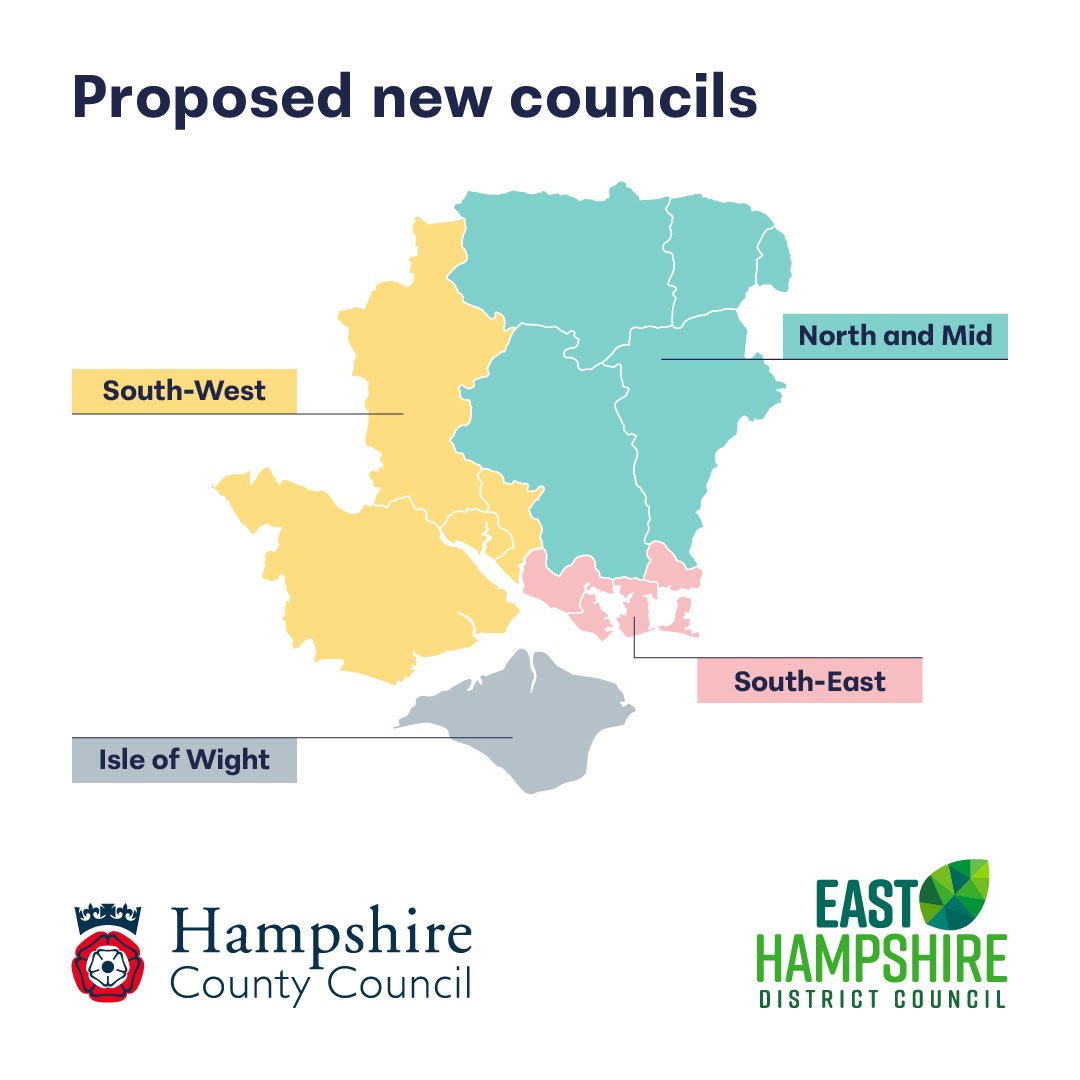
Following detailed analysis of robust evidence and data to underpin proposals for the Hampshire and Solent area, Hampshire County Council believes the best model of local government for our area would replace the current 15 councils across the Hampshire and Solent area with four new unitary councils. (Three new councils would be created on the Hampshire and Solent area mainland, and the Isle of Wight would remain a standalone unitary council, as it is now.)
The proposed unitary council areas are:
- North and Mid Hampshire (Basingstoke and Deane, East Hampshire, Hart, Rushmoor, Winchester)
- South-West Hampshire and Solent (Eastleigh, New Forest, Southampton, Test Valley)
- South-East Hampshire and Solent (Fareham, Gosport, Havant, Portsmouth)
- Isle of Wight (remaining as a standalone unitary council)
This model is designed to make things simpler by reducing duplication, improving service delivery to residents, and delivering estimated annual savings of almost £50 million – helping to protect essential frontline services to those people who need them the most, and ensure the long-term financial sustainability of the new councils created.
A model built to last
Councillor Nick Adams-King, Leader of Hampshire County Council, said: “This is one of the most significant decisions about the future of local government in our area for a generation, and it’s vital that we approach it with care, rigour, and a clear focus on what will deliver the best outcomes for residents. Government expects all parts of the country to reorganise so we’re determined to ensure it delivers the best possible outcome for our residents.
“I wish to thank County Councillors from all parties and across the county for their contributions to this important discussion. Their insights have helped shape the work we’ve done to date and will continue to be vital as we move forward.
“We know that other councils are also developing their own ideas which will also be submitted to central Government alongside our own, for a final decision by Ministers this autumn, and that’s a healthy part of the process. But when it comes to major changes that affect millions of people, evidence is absolutely essential and together with East Hampshire District Council, we believe we have a duty to do the hard work of testing our proposal using robust evidence and data, to make sure any future model is not only ambitious for our area, but also practical, deliverable, open and transparent, and built to last – giving equal weight to the identity of local places, quality of services that will be provided, and financial resilience.
“That’s why our preferred model is grounded in detailed analysis and decades of experience delivering complex services like social care for vulnerable children and adults, education, and highways. It offers the best balance of simplicity, stability, and savings – building councils that are large enough to be resilient, but local enough to stay connected to the communities they serve.”
The Cabinet’s decision follows approval of the proposal by the Full County Council on 17 July as part of a detailed report setting out the rationale for the preferred model, including financial analysis, the impact on the future delivery of services to local communities, and the importance of maintaining strong local identity.
A public engagement exercise will now run from 21 July to 17 August, giving residents, businesses, stakeholders and community organisations across Hampshire and the Solent area the opportunity to share their views on the proposal.
Next steps
The responses and feedback gathered during this process will be carefully analysed and used to shape Hampshire County Council’s final proposal for local government reorganisation. This updated proposal will then be considered by the full County Council and Cabinet in September 2025. If approved, it will be submitted to central Government which will then review all submissions and carry out its own public consultation before making a final decision on the future structure of local government in our area.
To find out more, visit: www.hants.gov.uk/lgr



latest video

news via inbox
Nulla turp dis cursus. Integer liberos euismod pretium faucibua