Wiltshire Council publishes its 2026/27 budget proposals – committing to provide vital services despite financial challenges
Wiltshire Council has published its draft budget proposals for 2026/27, which detail how it will spend £567m on vital services to support the county’s residents, communities and businesses.
The published draft is now open for scrutiny and feedback, including through a public webinar which takes place on 28 January at 6pm. Residents can also find out more and have their questions answered and If anyone wants to submit any in advance they should send them to communications@wiltshire.gov.uk by 5pm on 27 January. People can find out all the details at Public budget webinar – join us to hear about the council’s 2026/27 budget proposals – Wiltshire Council.
The council has a legal obligation to set a balanced budget, and its proposals outline how it will achieve that. Amidst the background of a very challenging financial climate for local authorities up and down the country, the council is proposing a net £40m increase in spend on services compared to 2025/26, which will help it to achieve the priorities set out in its 10-year Our Wiltshire Plan.
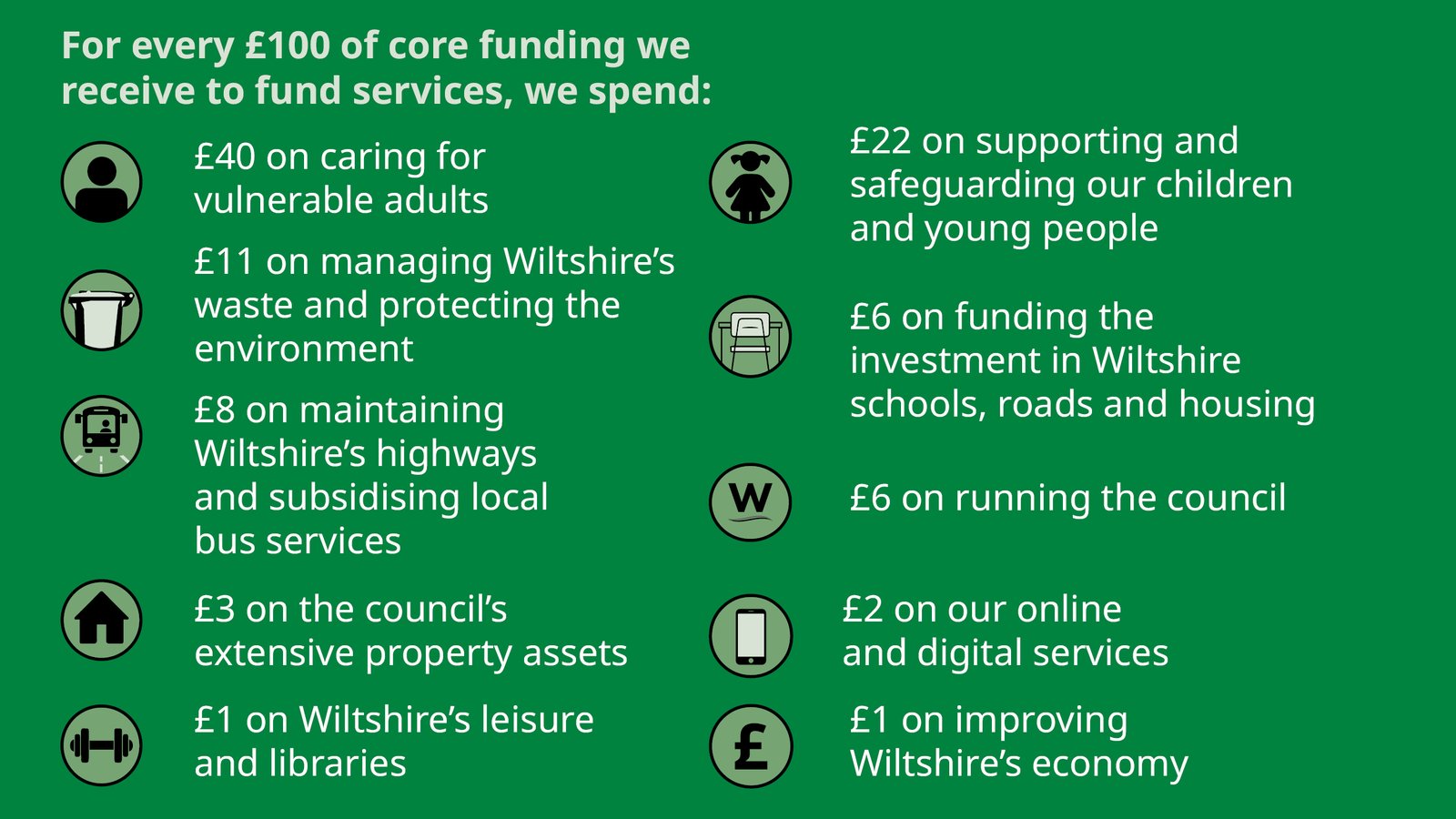
The most significant areas of spend will be:
- Adult services – £224m
- Families and children – £79m
- Environment (including waste) – £62m
- Highways and transport – £44m
- Education and skills – £41m
The Government announced the Provisional Local Government Financial Settlement for 2026/27 in December 2025. This sets out expected grant allocations for councils and details each authority’s Core Spending Power. Nationally, Core Spending Power (the amount government says councils need to deliver its services) is set to increase by 5.7% in 2026/27, based on the assumption that councils will apply the maximum Council Tax permitted under regulations.
However, for Wiltshire Council, the increase in Core Spending Power is only 4.5%, which is significantly less than the average increases across the country. When excluding the Council Tax element, the increase in government funding represents just 0.7%, highlighting the continued financial challenge the council faces.
Several specific government grants have been consolidated into the Revenue Support Grant (RSG). Although announcements from government indicate new funding for councils, the overall amount remains similar to previous years for Wiltshire Council. The grant that was introduced last year as a transitional measure for council’s worth £600m nationally continues this financial year, but Wiltshire Council has not received any allocation from it. The final Local Government Finance Settlement is expected in early to mid-February.
The area putting the biggest pressure on council finances continues to be the cost of providing care, which has increased considerably in the last five years. The National Audit Office confirms a 96% increase in the cost to provide care for a 10% increase in demand between 2019/20 – 2024/25.
The most significant risk continues to be a substantially increasing deficit on the financial support for children and young people, with significant Special Educational Needs and Disabilities, known as the ‘High Needs Block’, which is a specific part of the UK’s Dedicated School’s Grant. The current and forecast demand in this area exceeds the allocation of funding from the Department for Education in 2026/27 by more than £64m. Budgeted pressures are also being felt, particular in care services, due to inflation and the changes to employers’ contribution to National Insurance. The government does compensate local authorities for the National Insurance contributions, but Wiltshire Council only receives around £3.2m when the actual cost pressure is around £4m for its employees alone, not for providers and suppliers it contracts with. No government funding was provided for the council’s many contractors and suppliers, particularly in care services.
Despite these challenges, the council is committed to continuing to build on the progress it is making, such as:
- Its Transforming Adult Social Care Programme continues to develop – including changing how the council works with people at the first point of contact to ensure they’re getting the right support and information at the earliest opportunity. The council also continues to develop its system for payment to providers, ensuring this is as thorough and efficient as possible, and delivering value for money.
- Highways improvements – In the Department for Transport’s latest assessment of local road maintenance performance, Wiltshire Council has been rated green, making it one of only 16 councils to receive this top rating. The council’s draft budget provides additional investment into local highways maintenance. It has adopted best practice including preventative maintenance and other innovative technologies. In 2025, pothole reports to the council have fallen by 28% compared to 2024.
- Investment in the future of waste and recycling – the council is putting the infrastructure in place to transform its waste and recycling kerbside collection services from 2027 (giving residents the opportunity to recycle even more at home) aimed at a big increase in current recycling rates.
- Early intervention and prevention – the council’s early help offer, Family Hubs and work with its young people at risk of coming into care are some of its key areas of strength. The council’s Stronger Families Team has demonstrated success in preventing 87 children coming into care during 2025/26.
- Shared Lives – a programme in which people live with and support adults with learning difficulties, mental or physical health needs, or are elderly and need support and care to live as independently as possible in the community. There are currently more than 50 Shared Lives carers.
The council receives nearly 84% of its corporate funding from Council Tax and Business Rates, although only 28% of the value of Business Rates comes into the council. So, it is dependent on increases in these to deliver services to Wiltshire’s residents, communities, and businesses. Therefore, the council is proposing a 2.99% general increase in Council Tax with a proposal of a 2% levy, permitted by government, specifically for Adult Social Care. The levy will raise £7.4m and will help to fund in part the £28m of additional inflation and demand growth that has been built into the Adult Social Care budget, which should provide sufficient funding to enable the delivery of vital services. This means that the Wiltshire Council element of council tax would be set at £389.373m for 2026/27 with a Band D charge of £1,981.15, an increase of £1.81 per week.
Cllr Gavin Grant, Cabinet Member for Finance, said: “Our proposed budget is ambitious, sustainable and with a strong focus on providing value for money, while reflecting the values and priorities of this council. It strikes the challenging but essential balance of supporting those residents who rely on us the most and continuing to invest in the future of Wiltshire, while operating within a very difficult and uncertain time for local government financing.
“We would of course like to do even more, but government funding has left councils like ours with limited flexibility. Rural counties are faring worse in government funding than our metropolitan counterparts. Demand for care services and the increasing cost of providing them remain significant, with pressures being felt here and right across the country. Without meaningful national reform, these challenges will persist.
“To deliver a balanced budget, savings are unavoidable, but every proposal has been considered carefully. We are committed to driving efficiency and innovation wherever possible, while ensuring our priority of supporting those most in need remains. This reflects what was said in our public and staff engagement last year, where people identified that our top priorities should be families and children’s services, education, and adult care. I once again want to thank everyone, both the public and our staff, who gave us their views and thoughtful ideas.
“Despite the financial challenges, we remain determined to build on the progress we’ve made, such as continuing to transform our adult social care, delivering modern affordable homes, increasing recycling and repairing our roads, while protecting children and supporting them to thrive.
“Wiltshire and the residents we serve deserve nothing less, and we will continue to work tirelessly to move forward, working in positive partnership to deliver the maximum value for money, while operating within our means.”
At the conclusion of the 2024/25 financial year, which covered the period of 1 April 2024 to 31 March 2025, the council had a revenue overspend of £4.853m. The books legally had to be balanced, so in June 2025, Cabinet agreed to approve the use of earmarked reserves. This ensured the position was able to be balanced.
The 2026/27 proposals do not propose to use reserves to balance the budget. However, having a sufficient reserve is prudent and essential, meeting the level of financially assessed risk. For 2025/26, this was set at £34m and for 2026/27 the level of risk, and therefore the fund, remains at a similar level.
The proposals put forward require the council to make significant savings, more so than in recent years. In 2026/27, around £24.1m of new savings have been identified, with an additional £5.3m that were previously agreed in last year’s budget.
The council’s leadership team was tasked to find efficiency savings that ensure the ongoing pressures can be met, with a focus on protecting preventative and early help services. Some of the savings include ensuring certain services are designed in such a way that they are the most effective and efficient; reviewing staff vacancies; increasing the use of artificial intelligence and automation where appropriate; ensuring the council is making the best use of its own assets and buildings; investing in new children’s homes and supported accommodation so they don’t have to go elsewhere at more expense; ensuring the council gets the best value out of all of its procurement and contractual arrangements; and increasing fees and charges to take account of inflation.
The council has also published its 2026/27 capital strategy and programme, which outlines how it will manage and invest in the county’s infrastructure. It is likely the capital budget may well change throughout the year as it is common for timeframes on major capital projects to move, particularly given the breadth of external impacts on delivering such large projects. The proposed budget for the 2026/27 programme is around £260m and more than £1bn across future years.
The 2026/27 capital spend includes:
- £15m – highways improvements including resurfacing of roads and pothole management
- £3.3m – to support people to make their homes more energy efficient through the Warm Homes: Local Grant Scheme
- £1m – fitness equipment for leisure centres
- £10.8m – A350 Chippenham bypass
- £16.1m – structural maintenance and bridges
- £27m – new house building programme
- £13m – towards the continuing development and construction of the new leisure centre in Trowbridge
- £12.1m – maintenance and modernisation of schools
No final decisions on the proposals have been made. The final proposals will be agreed by the council’s Cabinet prior to being discussed and debated at Full Council on 24 February at County Hall from 10:30am.
Meanwhile, the draft proposals will be scrutinised by various groups including members, group leaders, trade union representatives and various committees and task groups. The draft budget proposals can be found at Agenda – Democratic Services – Wiltshire Council



latest video

news via inbox
Nulla turp dis cursus. Integer liberos euismod pretium faucibua